
TEACHER TRANSFORMATION & PROFESSIONAL DEVELOPMENT PROGRAM
THE WHY BEHIND THE PROGRAM
A teacher doesn’t simply teach a subject.
A teacher influences how a child thinks, communicates, responds to challenges, sees themselves, and experiences learning.
In today’s rapidly changing educational environment, educators are expected to do much more than deliver curriculum. They are mentors, facilitators, role models, listeners, communicators and, often, the first people to notice when a student is struggling.
This program is designed to help educators strengthen the skills behind effective teaching — from communication and classroom presence to emotional intelligence, self-awareness, student connection and personal wellbeing.
It is a practical, experiential and reflective training designed to help teachers become more confident in their presence, intentional in their communication and impactful in their classrooms.
CORE TRAINING MODULES
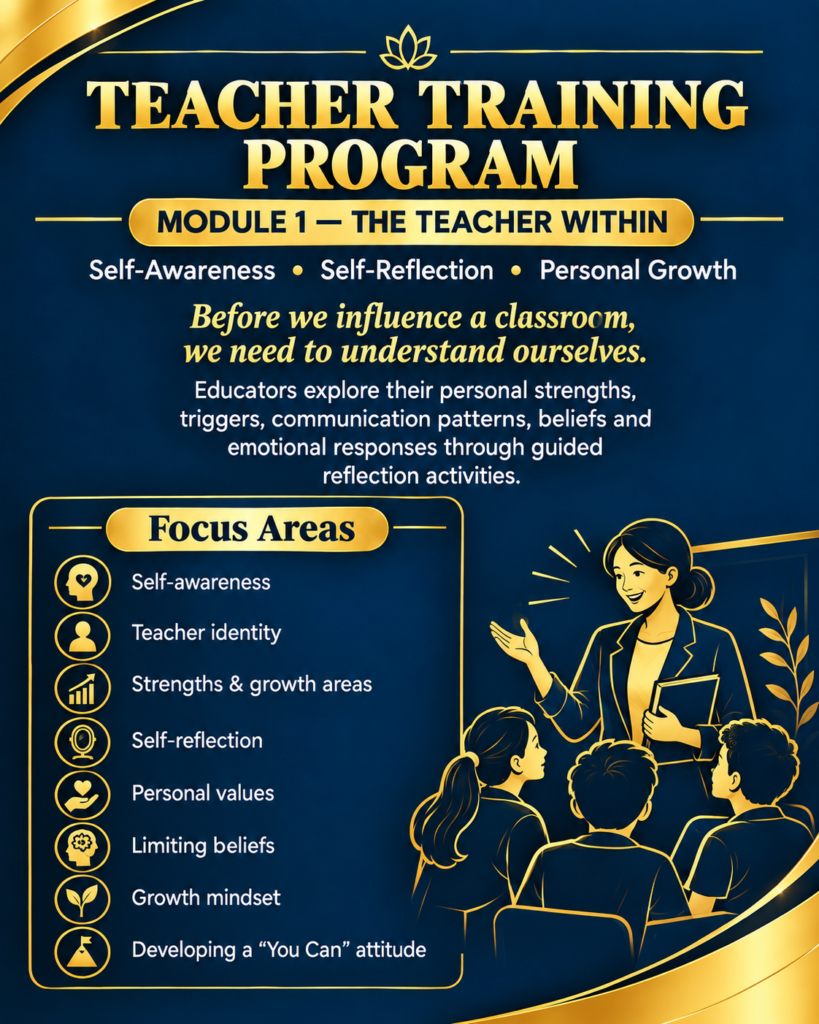
MODULE 1 — THE TEACHER WITHIN
Self-Awareness • Self-Reflection • Personal Growth
Before we influence a classroom, we need to understand ourselves.
Educators explore their personal strengths, triggers, communication patterns, beliefs and emotional responses through guided reflection activities.
Focus areas:
- Self-awareness
- Teacher identity
- Strengths & growth areas
- Self-reflection
- Personal values
- Limiting beliefs
- Growth mindset
- Developing a “You Can” attitude
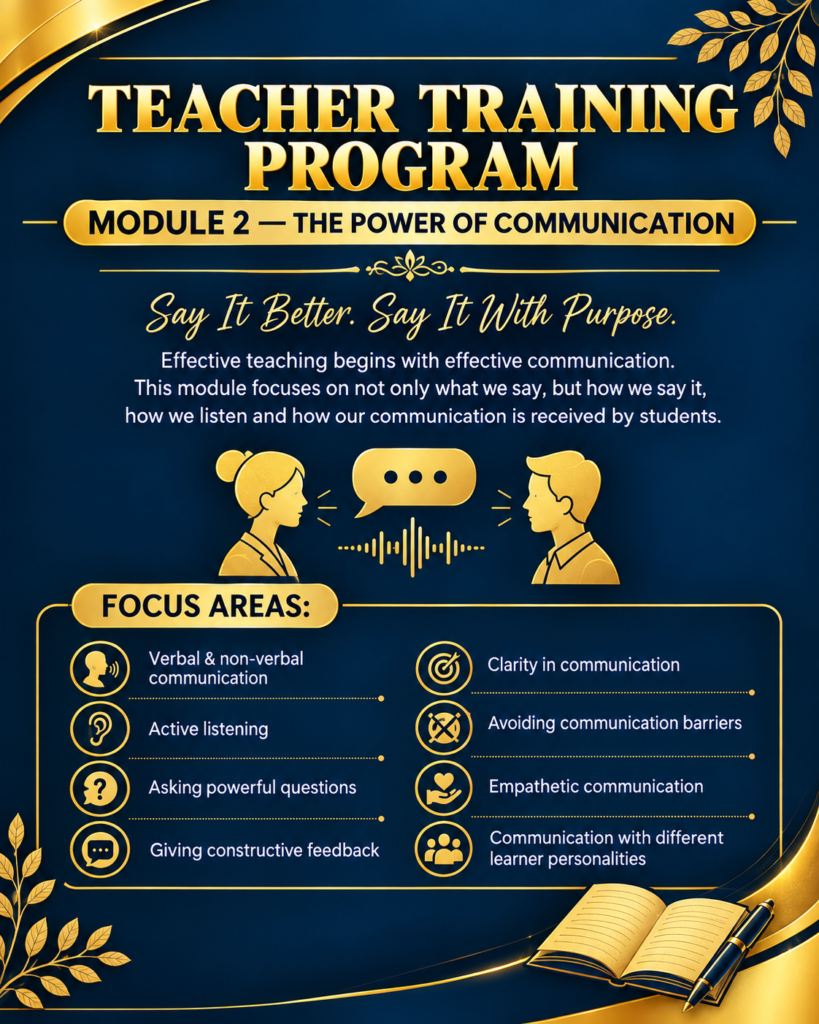
MODULE 2 — THE POWER OF COMMUNICATION
Say It Better. Say It With Purpose.
Effective teaching begins with effective communication.
This module focuses on not only what we say, but how we say it, how we listen and how our communication is received by students.
Focus areas:
- Verbal & non-verbal communication
- Active listening
- Asking powerful questions
- Giving constructive feedback
- Clarity in communication
- Avoiding communication barriers
- Empathetic communication
- Communication with different learner personalities
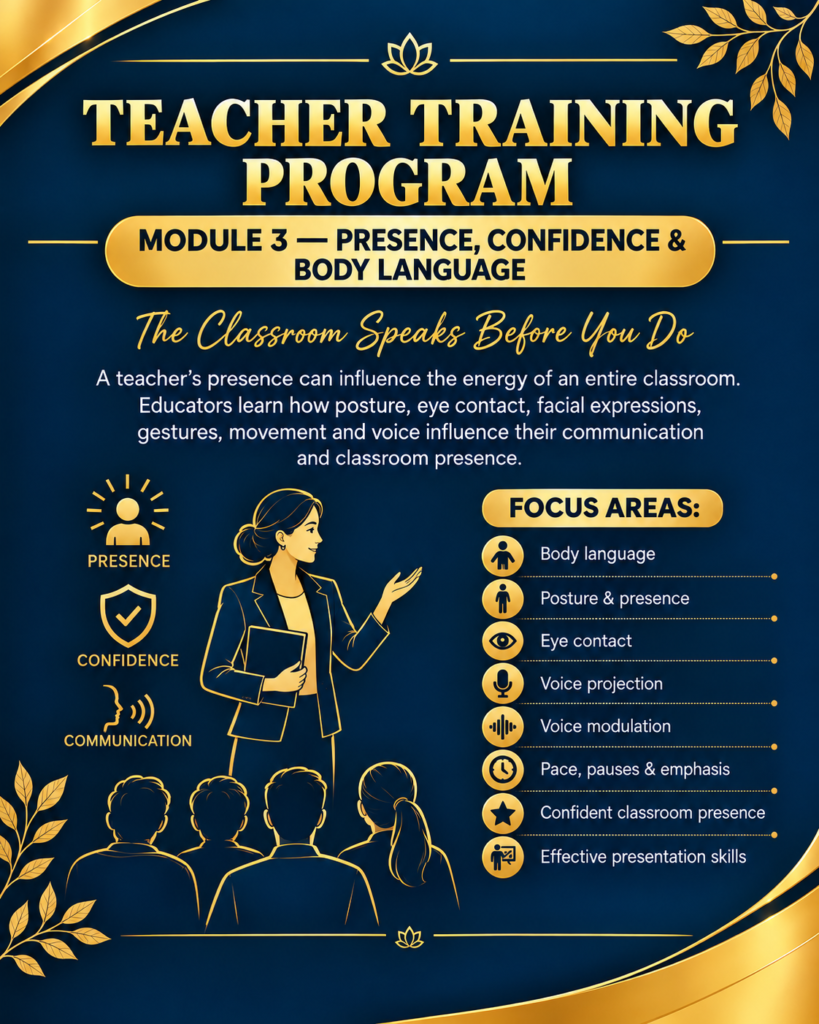
MODULE 3 — PRESENCE, CONFIDENCE & BODY LANGUAGE
The Classroom Speaks Before You Do
A teacher’s presence can influence the energy of an entire classroom.
Educators learn how posture, eye contact, facial expressions, gestures, movement and voice influence their communication and classroom presence.
Focus areas:
- Body language
- Posture & presence
- Eye contact
- Voice projection
- Voice modulation
- Pace, pauses & emphasis
- Confident classroom presence
- Effective presentation skills
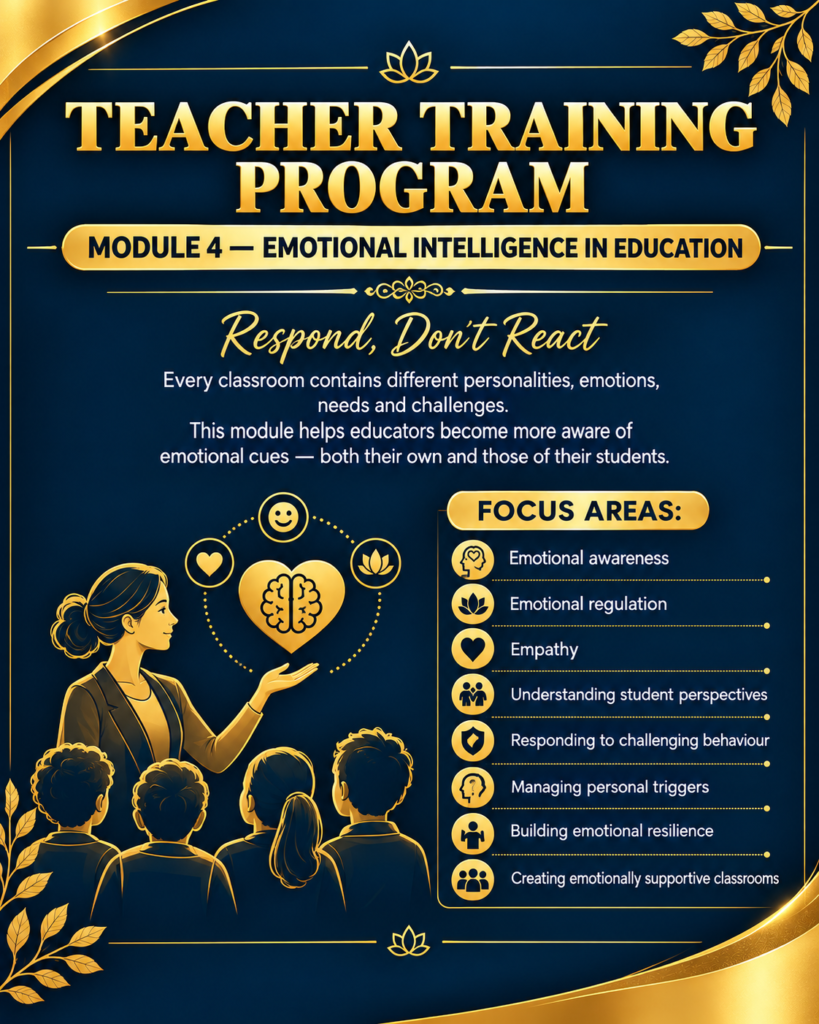
MODULE 4 — EMOTIONAL INTELLIGENCE IN EDUCATION
Respond, Don’t React
Every classroom contains different personalities, emotions, needs and challenges.
This module helps educators become more aware of emotional cues — both their own and those of their students.
Focus areas:
- Emotional awareness
- Emotional regulation
- Empathy
- Understanding student perspectives
- Responding to challenging behaviour
- Managing personal triggers
- Building emotional resilience
- Creating emotionally supportive classrooms
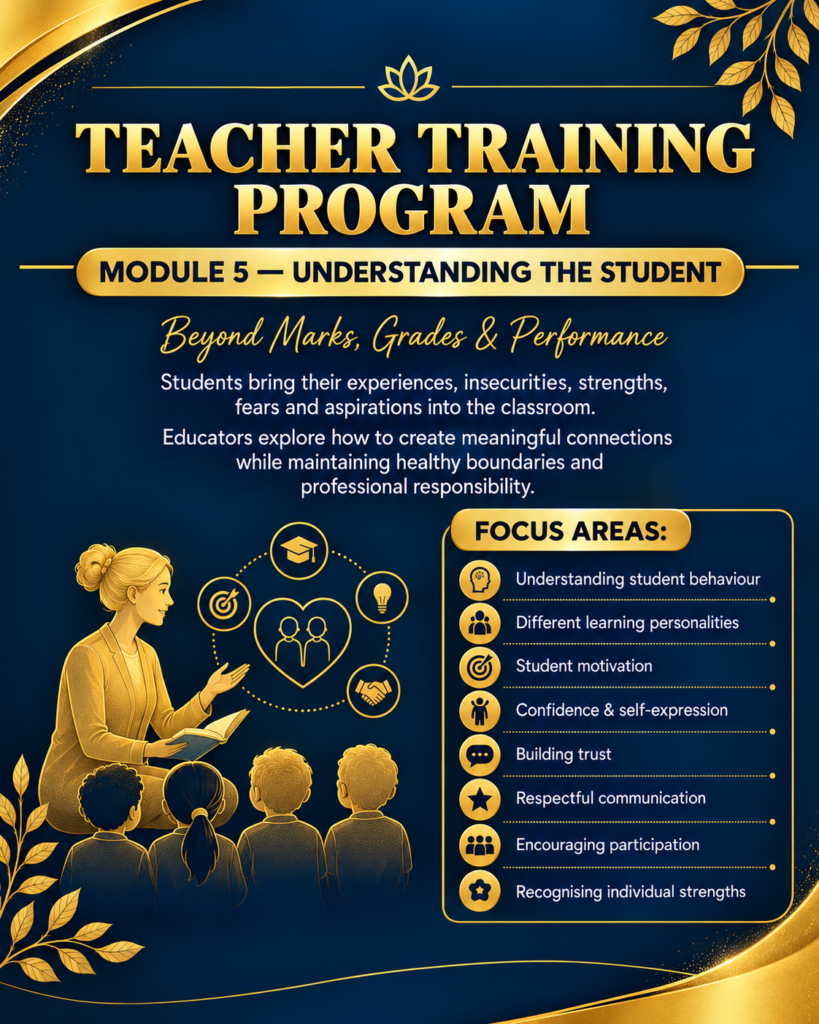
MODULE 5 — UNDERSTANDING THE STUDENT
Beyond Marks, Grades & Performance
Students bring their experiences, insecurities, strengths, fears and aspirations into the classroom.
Educators explore how to create meaningful connections while maintaining healthy boundaries and professional responsibility.
Focus areas:
- Understanding student behaviour
- Different learning personalities
- Student motivation
- Confidence & self-expression
- Building trust
- Respectful communication
- Encouraging participation
- Recognising individual strengths
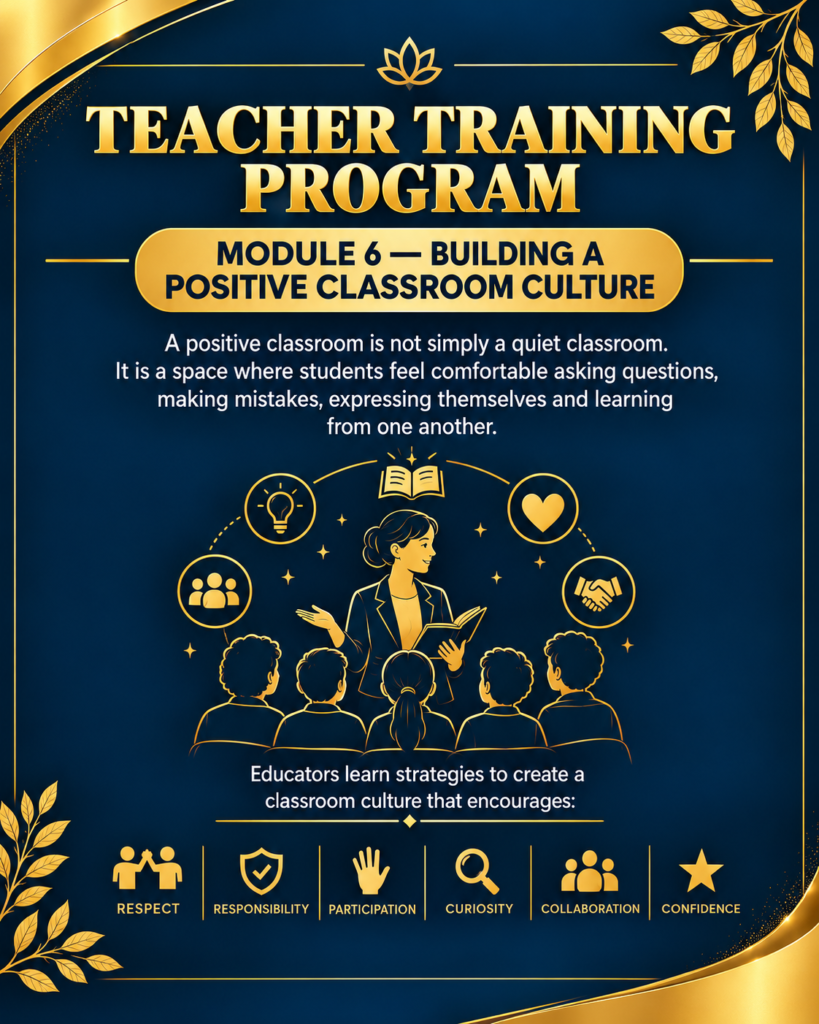
MODULE 6 — BUILDING A POSITIVE CLASSROOM CULTURE
A positive classroom is not simply a quiet classroom.
It is a space where students feel comfortable asking questions, making mistakes, expressing themselves and learning from one another.
Educators learn strategies to create a classroom culture that encourages:
Respect • Responsibility • Participation • Curiosity • Collaboration • Confidence
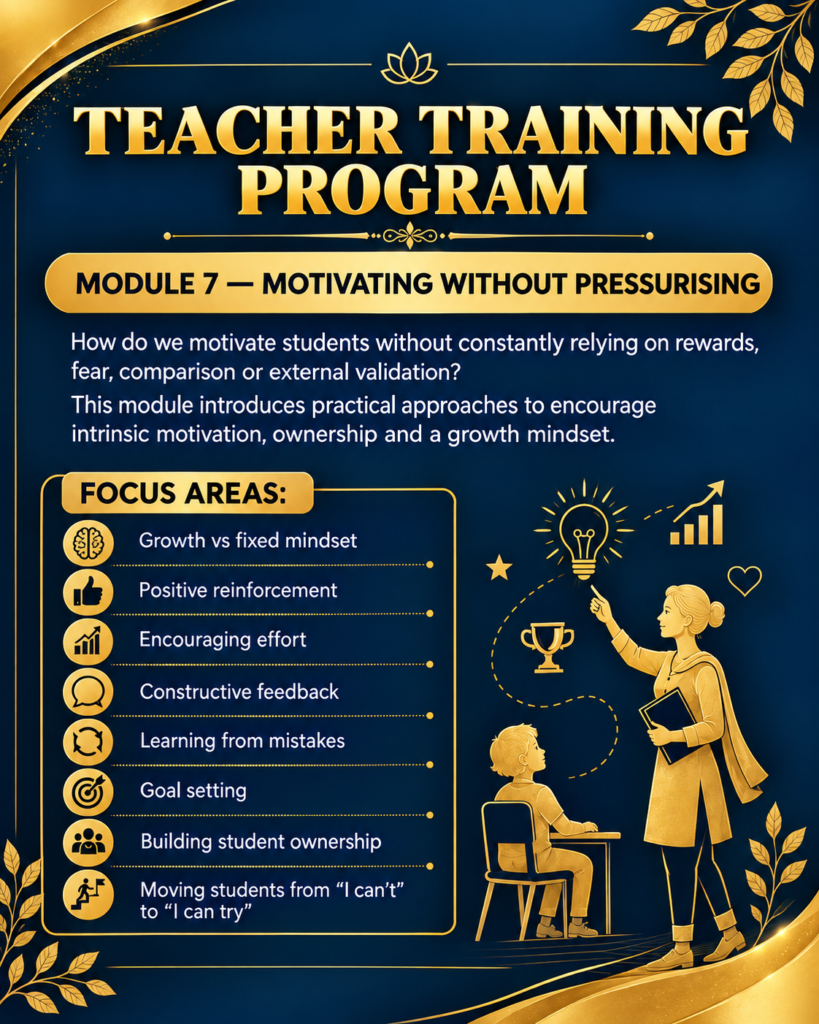
MODULE 7 — MOTIVATING WITHOUT PRESSURISING
How do we motivate students without constantly relying on rewards, fear, comparison or external validation?
This module introduces practical approaches to encourage intrinsic motivation, ownership and a growth mindset.
Focus areas:
- Growth vs fixed mindset
- Positive reinforcement
- Encouraging effort
- Constructive feedback
- Learning from mistakes
- Goal setting
- Building student ownership
- Moving students from “I can’t” to “I can try”
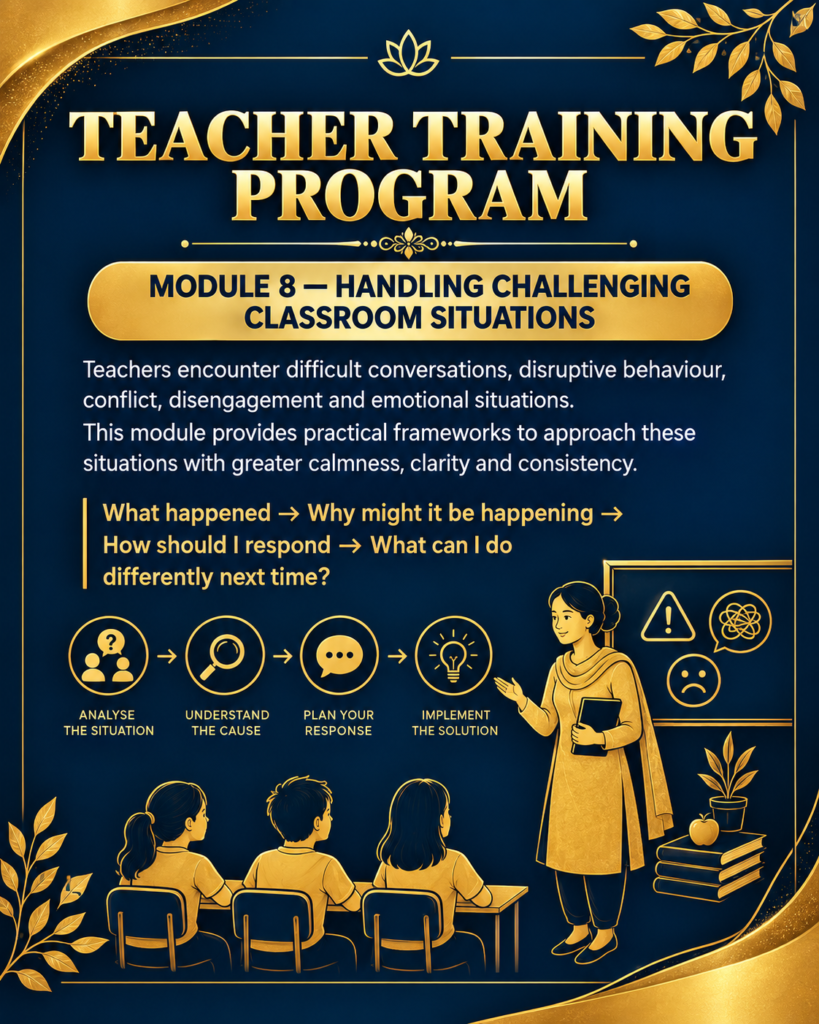
MODULE 8 — HANDLING CHALLENGING CLASSROOM SITUATIONS
Teachers encounter difficult conversations, disruptive behaviour, conflict, disengagement and emotional situations.
This module provides practical frameworks to approach these situations with greater calmness, clarity and consistency.
Educators work through real-life classroom scenarios and identify:
What happened → Why might it be happening → How should I respond → What can I do differently next time?
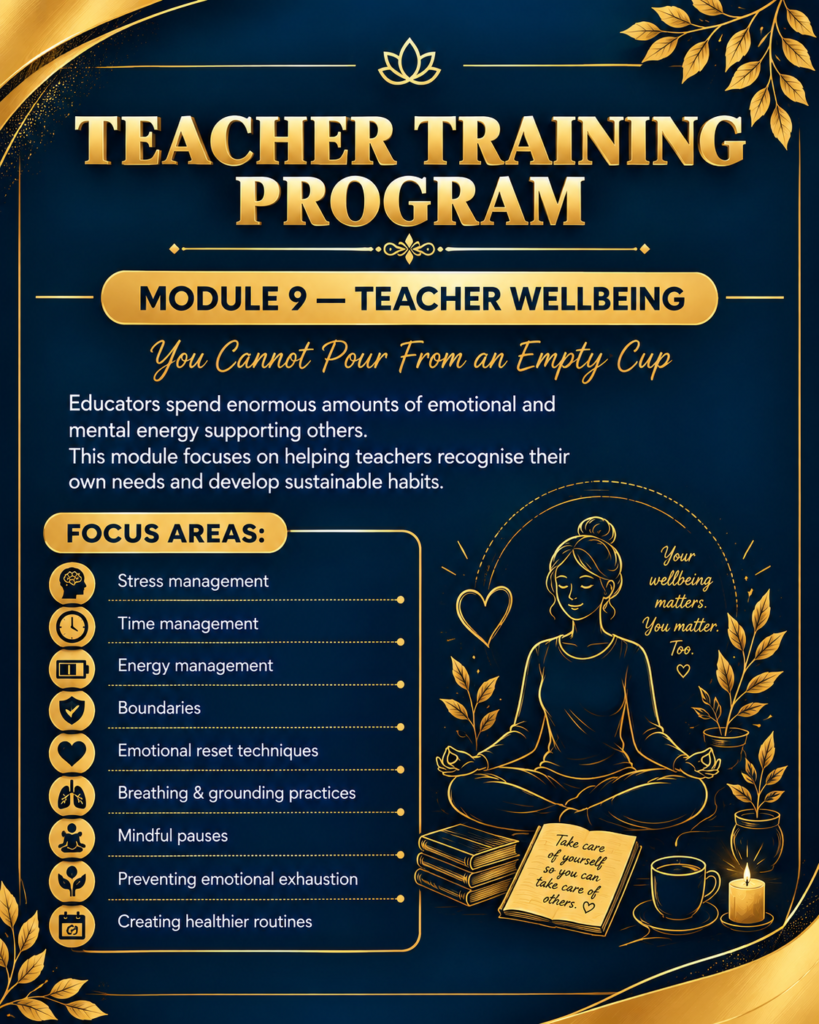
MODULE 9 — TEACHER WELLBEING
You Cannot Pour From an Empty Cup
Educators spend enormous amounts of emotional and mental energy supporting others.
This module focuses on helping teachers recognise their own needs and develop sustainable habits.
Focus areas:
- Stress management
- Time management
- Energy management
- Boundaries
- Emotional reset techniques
- Breathing & grounding practices
- Mindful pauses
- Preventing emotional exhaustion
- Creating healthier routines
MODULE 10 — BRINGING JOY BACK INTO TEACHING
Teaching should not become a repetitive cycle of lesson plans → assessments → deadlines → reports.
This module encourages educators to rediscover creativity, curiosity and joy in their profession.
Participants explore simple ways to make learning more:
Interactive • Experiential • Engaging • Creative • Student-centred
THE TRAINING METHODOLOGY
This is not a lecture-only training program.
The sessions are designed to be highly interactive and experiential, incorporating:
- Real-life classroom scenarios
- Role plays
- Group discussions
- Reflection exercises
- Communication activities
- Self-assessment exercises
- Case studies
- Situation-based problem solving
- Peer learning
- Practical classroom strategies
- Guided mindfulness and breathing exercises
- Action-planning activities
Teachers are encouraged to participate, reflect, practise and apply rather than simply listen.
WHAT EDUCATORS TAKE AWAY
By the end of the program, educators will have:
✓ Greater awareness of their communication style
✓ Practical tools for improving classroom communication
✓ Increased confidence and classroom presence
✓ Better understanding of emotional intelligence
✓ Strategies for handling challenging situations
✓ Tools to build stronger student relationships
✓ Practical growth-mindset strategies
✓ Techniques for improving student engagement
✓ Stress, grounding and emotional reset techniques
✓ A personal reflection framework for continuous professional growth
✓ A practical Teacher Action Plan to implement after the training
THE BIGGER IMPACT
When we invest in teachers, we don’t impact one person.
We impact every classroom they enter.
Every student they teach.
Every conversation they have.
Every child who begins to believe, “I can.”
The ultimate objective of this program is to create educators who don’t merely complete the curriculum but create an environment where students feel seen, respected, encouraged and capable of becoming their best selves.
**Because education is not only about what we teach.
It is about what students begin to believe about themselves because of us.**
PROGRAM FORMAT
Designed for:
Schools • Colleges • Educational Institutions • Teacher Communities
Format:
Interactive Workshops • Faculty Training • Professional Development Sessions • Half-Day / Full-Day Programs • Customised Institutional Programs
Participants:
Teachers • Faculty Members • Coordinators • Academic Leaders • Mentors
Duration:
Can be customised according to institutional requirements — from focused 90-minute sessions to half-day and full-day professional development programs.
The program can also be customized based on the institution’s specific requirements, teacher profile, age groups taught and identified areas of development.
